
How Retaining Walls Solve Erosion Problems on Sloped Properties in Banner Elk, NC
Living in the mountains around Banner Elk, NC, comes with some incredible advantages, from beautiful views of the Blue Ridge Mountains to wooded properties surrounded by natural scenery. However, those steep hillsides that make the High Country so appealing can also create serious landscaping challenges. Maybe you’ve noticed soil washing onto your driveway after heavy rain, a section of your yard gradually slipping downhill, or deep channels forming where stormwater travels across your property. For homeowners, vacation rental owners, and property managers, these problems can become increasingly difficult to manage.
Retaining walls help control erosion by holding soil in place, supporting changes in elevation, and creating more stable areas on sloped properties. When properly designed and installed with suitable drainage, retaining walls can reduce soil movement, manage runoff, and provide usable outdoor space. However, effective erosion control involves more than stacking rocks or blocks along a hillside. The wall must be designed for the soil conditions, slope, water pressure, and surrounding landscape.
For Banner Elk property owners dealing with hillside erosion, several factors deserve attention:
- Retaining walls help stabilize slopes. Properties in Banner Elk and Sugar Mountain can benefit from walls designed to support soil where significant elevation changes exist.
- Drainage is essential to wall performance. Heavy rainfall and snowmelt can saturate soil behind retaining walls, increasing pressure and the potential for failure.
- Different materials serve different purposes. Boulder retaining walls, concrete block systems, and tiered retaining walls provide options for varying terrain and landscape designs.
- Vegetation supports soil erosion prevention. Properties around Beech Mountain and Seven Devils may benefit from combining retaining walls with ground covers, shrubs, and other suitable plantings.
- Professional planning helps avoid costly mistakes. Proper excavation, foundation preparation, drainage, and construction methods are essential on challenging mountain properties.
At Twin Oaks Landscaping, Inc., we’ve spent over 20 years helping property owners throughout Banner Elk and the surrounding High Country maintain attractive, functional outdoor spaces. As a family-owned landscaping company, we combine our knowledge of mountain terrain with professional hardscaping, erosion control, drainage improvements, and landscape design services to develop solutions suited to each property’s needs.
Why Are Sloped Properties in Banner Elk Vulnerable to Erosion?
Sloped properties in Banner Elk are vulnerable to erosion because gravity and moving water work together to carry loose soil downhill. Heavy rainfall, concentrated runoff, exposed ground, and changes in soil moisture can accelerate this process, particularly on steep hillsides without sufficient vegetation or drainage controls.
Heavy Rainfall and Mountain Runoff
The High Country experiences substantial precipitation throughout the year, including heavy rain and winter weather. When rain falls on steep terrain, water may travel downhill quickly rather than soaking evenly into the ground.
As runoff gains momentum, it can loosen and transport soil, especially where grass, shrubs, and other vegetation are sparse.
Over time, repeated storms may create channels, undermine landscape features, or deposit sediment along driveways and walkways.
Soil Movement and Freeze-Thaw Conditions
Mountain properties also experience seasonal freezing and thawing. Moisture within the soil can freeze, expand, and thaw, contributing to changes in soil conditions near retaining walls and exposed slopes.
However, not every hillside experiences the same level of instability. Soil composition, drainage patterns, slope angle, and nearby construction all influence erosion risks.
For mountain property landscaping in communities such as Valle Crucis and Foscoe, these conditions make a site-specific evaluation especially valuable.
How Do Retaining Walls Help Prevent Soil Erosion?
Retaining walls help prevent soil erosion by supporting earth along changes in elevation and reducing the movement of soil into lower areas. When combined with proper drainage and surface stabilization, they can also help manage runoff and create more controlled transitions between different sections of a property.
Supporting Soil on Steep Hillsides
A properly constructed retaining wall resists pressure from the soil behind it. This allows property owners to establish a supported grade where the surrounding terrain might otherwise be too steep for practical landscaping.
For example, a hillside leading down toward a driveway may benefit from a retaining wall designed to hold the upper soil in place.
However, the wall must be designed to handle the expected soil pressure and any additional loads from nearby structures, vehicles, or other features.
Creating More Manageable Landscape Areas
Retaining walls can also divide steep terrain into smaller, more usable sections. This makes it possible to establish planting beds, walkways, lawns, or outdoor gathering areas where the original slope created limitations.
For homeowners near Sugar Mountain or Beech Mountain, these improvements can make outdoor spaces more functional without completely eliminating the property’s natural contours.
Reducing Ongoing Soil Washout
By combining structural soil support with drainage improvements, retaining walls can help reduce the amount of loose material washed downhill during storms.
However, a retaining wall alone doesn’t automatically solve every erosion problem. Water must still be managed, and surrounding exposed soil may require vegetation or other stabilization methods.
What Types of Retaining Walls Work Best for Mountain Properties?
The best retaining wall for a mountain property depends on the slope, soil conditions, required wall height, drainage requirements, and desired appearance. Boulder walls, segmental block walls, and tiered retaining wall designs each offer advantages, but structural suitability should come before aesthetic preferences.
Boulder Retaining Walls
Boulder retaining walls are popular for mountain landscaping because their natural stone appearance complements wooded hillsides and rustic architecture.
Large stones can create attractive transitions between different elevations while providing substantial mass for certain wall designs.
At Twin Oaks Landscaping, Inc., our boulder wall installations are designed to complement the surrounding High Country landscape while addressing functional site requirements.
Concrete Block Retaining Walls
Segmental block retaining walls provide a more structured appearance, with consistent dimensions and various color and texture options.
Depending on the wall’s design, these systems may use engineered reinforcement, properly prepared base materials, and drainage components to support retained soil.
Block walls can work well near driveways, garden beds, and outdoor living areas where homeowners prefer a clean, finished appearance.
Tiered Retaining Walls
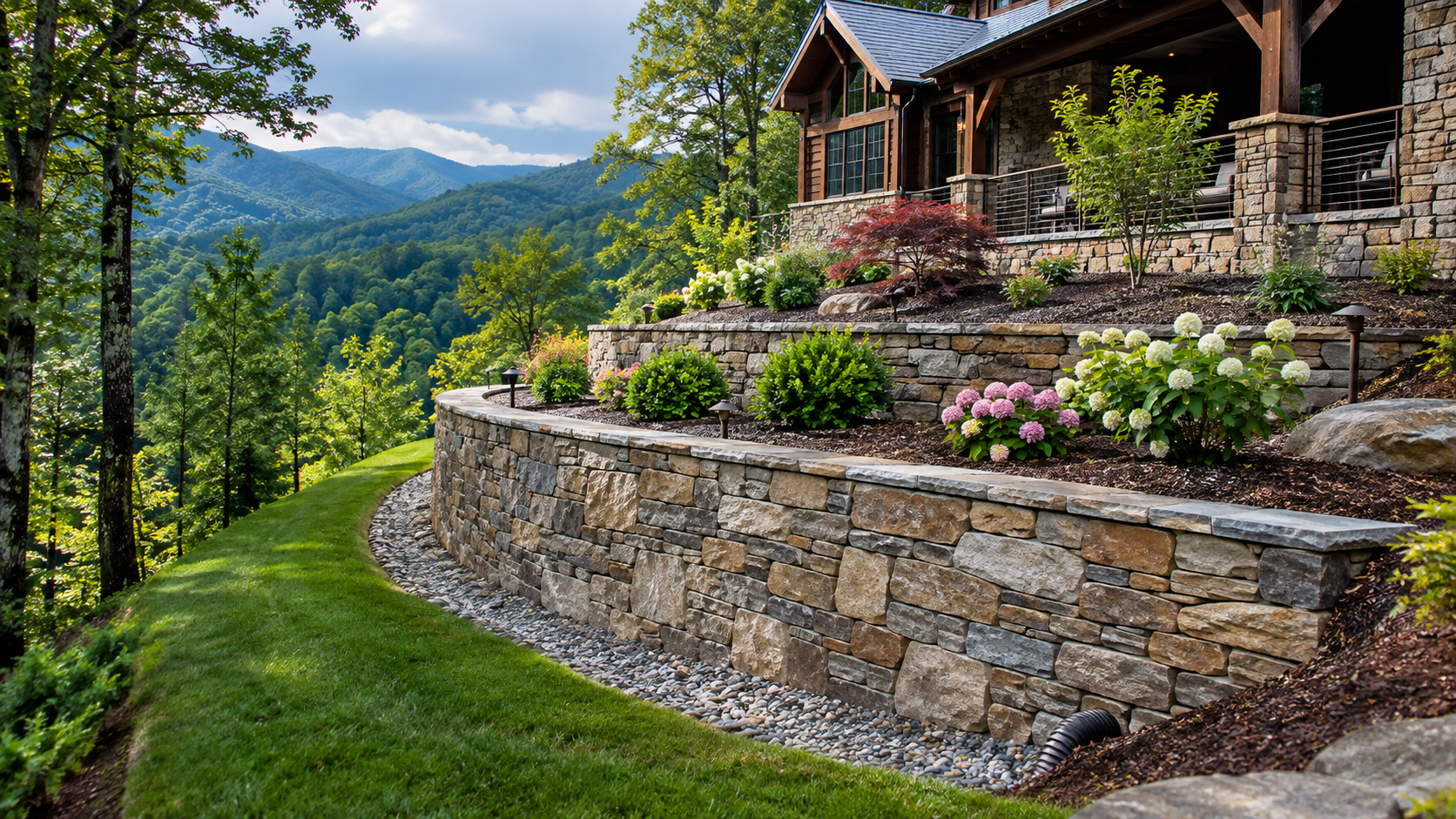
Tiered retaining walls create several smaller landscape levels instead of relying on one continuous wall.
For properties with substantial elevation changes, this approach may provide attractive planting spaces and more gradual transitions.
However, the spacing and height of individual walls must be carefully designed because one wall can affect the soil pressure and stability of another.
Our team helps property owners explore wall configurations that balance functional slope stabilization with the appearance of their outdoor spaces.
Why Is Drainage So Important Behind Retaining Walls?
Drainage is critical behind retaining walls because water accumulating in the retained soil increases pressure against the structure. Without an appropriate way for water to escape, even a well-built wall may experience movement, cracking, bulging, or eventual failure.
Understanding Hydrostatic Pressure
When soil becomes saturated, water creates additional pressure against the wall. This is known as hydrostatic pressure, and it can significantly increase the forces a retaining wall must resist.
For properties in Banner Elk, heavy rain and snowmelt make drainage especially important.
Depending on the design, drainage components may include:
- Free-draining gravel or stone behind the wall.
- Perforated drainage pipes that collect and direct water.
- Suitable filter fabric to help limit soil migration.
- Properly designed outlets that discharge water to appropriate locations.
- Surface grading that directs runoff away from vulnerable areas.
These components must work together as part of the overall system.
Managing Water Beyond the Wall
Water shouldn’t simply be redirected toward a neighboring property, driveway, or building foundation. Drainage outlets and surface runoff paths need careful consideration to avoid creating new erosion problems elsewhere.
We provide drainage and erosion solutions that complement our retaining wall installations, including grading, erosion-resistant materials, and other appropriate methods for managing water movement.
For property owners in Banner Elk and nearby Newland, addressing drainage alongside wall construction can help reduce recurring landscape problems.
How Can Retaining Walls and Landscaping Work Together?
Retaining walls and landscaping work together by combining structural soil support with vegetation that helps protect exposed ground from erosion. Walls manage significant elevation changes, while carefully selected plants, ground covers, and other softscape features can reduce surface runoff and improve the landscape’s appearance.
Using Plants to Help Stabilize Soil
Plant roots can help bind certain soils together, while leaves and ground cover reduce the direct impact of rainfall on exposed surfaces.
Suitable plantings may include shrubs, grasses, and other vegetation selected for the property’s sunlight, moisture, elevation, and soil conditions.
However, plant roots aren’t a substitute for engineered stabilization when a hillside presents significant structural risks.
Additional Erosion Control Techniques
Not every slope needs a retaining wall. Depending on the conditions, other solutions may include:
- Mulching and erosion-control matting.
- Hydro-seeding to establish vegetation.
- Rip-rap installation along appropriate drainage areas.
- Surface grading and runoff management.
- Ground covers and carefully planned planting beds.
Our approach to slope stabilization in High Country communities often combines hardscape elements with softscapes and drainage improvements.
This allows us to address both the practical challenges of erosion and the overall appearance of the property.
What Are the Warning Signs That a Sloped Property Needs Professional Attention?
Warning signs of hillside erosion include exposed roots, developing gullies, soil accumulating downhill, leaning retaining walls, and drainage patterns that repeatedly wash away landscaping materials. These symptoms can indicate that surface erosion or deeper soil movement requires professional evaluation.
Homeowners and property managers should pay attention to:
- Soil collecting at the bottom of slopes after rainfall.
- Channels or gullies forming through lawns and planting beds.
- Exposed tree roots or rapidly disappearing ground cover.
- Retaining walls that lean, bulge, or develop significant cracks.
- Water collecting behind existing walls.
- Soil washing across driveways, sidewalks, or patios.
- New ground cracks or noticeable movement near structures.
For vacation rental properties around Beech Mountain and Sugar Mountain, regular inspections are particularly useful because owners may not be present after every storm.
If you notice rapidly developing cracks, slope movement near a building, or signs of a potential landslide, keep people away from the affected area and seek an appropriate geotechnical or structural evaluation.
What Happens During Professional Retaining Wall Installation?
Professional retaining wall installation begins with evaluating the slope, soil conditions, drainage patterns, and the amount of earth that must be supported. The process then involves designing the appropriate wall, preparing a suitable foundation, installing necessary drainage and reinforcement, and completing the surrounding landscape.
Evaluating the Site
Our team begins by understanding how the property is used and what problems need to be addressed.
We consider the slope, existing erosion, equipment access, and the relationship between the proposed wall and nearby buildings, driveways, or outdoor living areas.
For challenging locations, engineering evaluation and additional site investigation may be necessary.
Preparing and Building the Wall
Construction may involve excavation, foundation preparation, compacted base materials, drainage installation, and careful placement of the selected wall materials.
Because mountain properties often have restricted access or uneven terrain, specialized equipment can be valuable during excavation and material handling.
Our experience with challenging High Country properties helps us plan practical installation approaches while keeping the surrounding landscape in mind.
Finishing the Landscape
Once the retaining wall is installed, the surrounding area may be graded, stabilized, and prepared for planting or additional hardscaping.
Some homeowners also use the project as an opportunity to add a paver patio, walkway, garden area, or another outdoor living feature.
For more substantial walls, structural engineering and applicable permits may be required. North Carolina’s Geological Survey specifically recommends experienced engineering design for taller retaining walls used to stabilize slopes near structures.
Frequently Asked Questions About Retaining Walls in Banner Elk, NC
Can retaining walls completely stop erosion on a steep mountain property?
Retaining walls can significantly reduce erosion by supporting soil and creating more stable landscape areas, but they don’t automatically eliminate every erosion problem. Effective results depend on proper design, drainage, grading, and surrounding soil stabilization. Some properties require additional vegetation or water management improvements.
What type of retaining wall is best for a sloped yard in Banner Elk?
The best wall depends on the slope’s characteristics, soil conditions, required height, and intended appearance. Boulder retaining walls offer a natural mountain aesthetic, while block systems provide more uniform finishes. Tiered designs may work well for larger elevation changes when properly engineered and spaced.
How much does retaining wall installation cost in the High Country?
Installation costs depend on wall dimensions, materials, soil conditions, excavation requirements, drainage components, and equipment access. Steep properties with limited access or significant stabilization needs may require additional work. A professional site evaluation provides a more accurate estimate than pricing based on wall length alone.
Do I need a permit to build a retaining wall in Banner Elk, NC?
Permit requirements depend on wall height, location, structural loads, grading activity, and applicable town or county regulations. Certain projects may also require engineering plans or erosion control approvals. Property owners should verify current requirements with the appropriate local authorities before beginning construction.
Can a retaining wall help prevent driveway erosion on Sugar Mountain properties?
Yes, a properly designed retaining wall can help support soil alongside a sloped driveway and reduce certain erosion concerns. However, driveway runoff must also be managed to prevent water from undermining the wall or washing out adjacent areas. Drainage improvements are often an essential part of the solution.
Are boulder retaining walls suitable for heavy rainfall in Banner Elk?
Boulder retaining walls can perform well in wet mountain environments when appropriately designed and constructed. Their suitability depends on factors including soil pressure, foundation conditions, stone placement, and drainage. Heavy rainfall makes proper water management especially important regardless of the wall material.
Can retaining walls create usable outdoor space on steep properties?
Yes, retaining walls can create more level areas for patios, gardens, walkways, and other landscape features. Tiered wall designs are particularly useful when a property has multiple changes in elevation. The layout must account for structural support, drainage, access, and the intended use of each space.
How do I know whether my existing retaining wall is failing?
Potential failure signs include leaning, bulging, widening cracks, displaced blocks or stones, and water accumulating behind the structure. Changes in the surrounding ground may also indicate instability. A qualified professional should evaluate these symptoms before repairs are attempted, especially when the wall supports a driveway or building.
Protect Your Mountain Property With Thoughtful Landscape Solutions
Owning a home or commercial property in the High Country means enjoying some of North Carolina’s most beautiful scenery, but it also means understanding how steep terrain and changing weather can affect your landscape. From soil washing onto driveways to unstable hillsides and limited usable yard space, erosion problems deserve attention before they become more disruptive. For homeowners, second-home owners, vacation rental operators, and property managers throughout Banner Elk, Sugar Mountain, Beech Mountain, Seven Devils, and nearby communities, properly designed retaining walls can be an important part of protecting and improving outdoor spaces.
At Twin Oaks Landscaping, Inc., we’ve spent over 20 years working with the distinctive terrain and landscaping needs of our mountain communities. As a family-owned company, we combine dependable service, specialized equipment, and practical landscape design experience to create retaining walls, drainage improvements, and attractive hardscapes suited to each property. Whether you’re considering boulder walls, tiered retaining walls, or a more comprehensive erosion control project, we’re here to help you explore solutions that balance stability, functionality, and natural beauty.
Strengthen Your Slope and Make More of Your Outdoor Space
Don’t let ongoing soil erosion limit how you use and enjoy your mountain property. Contact Twin Oaks Landscaping, Inc. today to discuss professional retaining wall installation, slope stabilization, and drainage and erosion solutions in Banner Elk, NC, and the surrounding High Country.